
🤖 AI Week 27: The Robots Learned to Be Less Annoying (Progress!)
Zero items queued, zero patches needed — but we’ve still got the best damn tech digest in your inbox. Buckle up for Week 27.

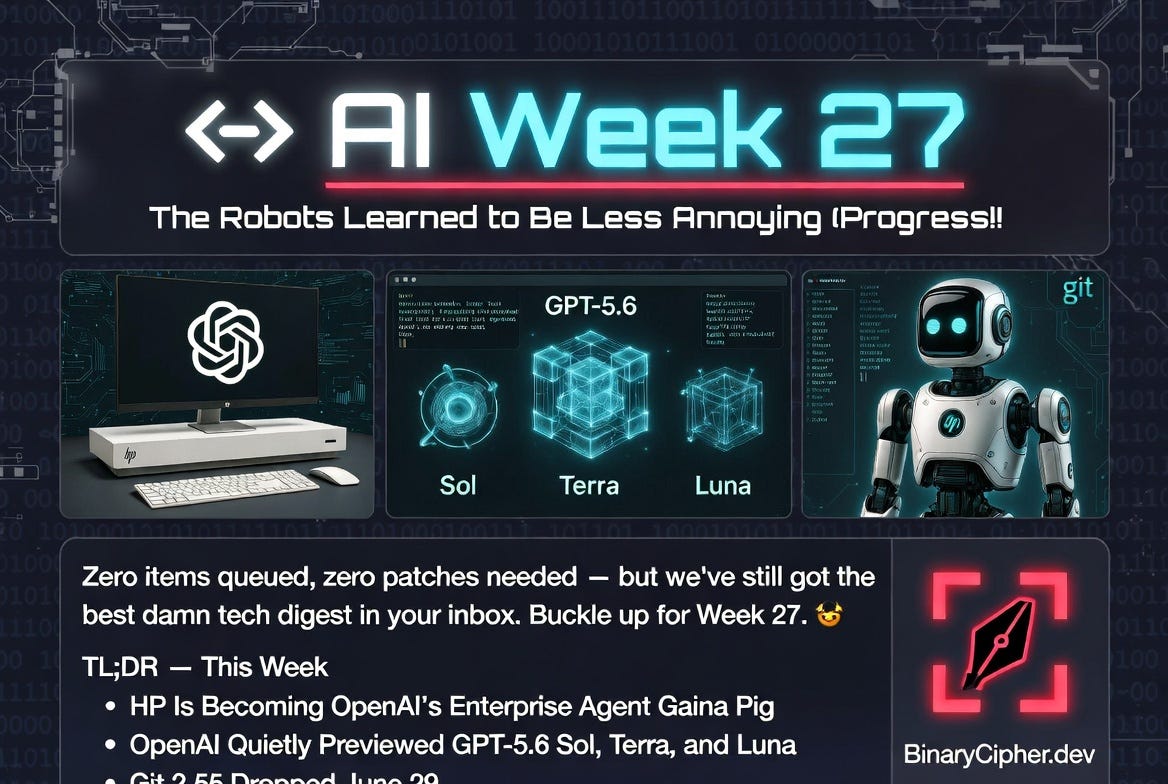
⚡ TL;DR — This Week
HP Is Becoming OpenAI’s Enterprise Agent Guinea Pig — And That’s Actually the Point
OpenAI Quietly Previewed GPT-5.6 Sol, Terra, and Luna — Here’s What the Names Betray
Git 2.55 Dropped June 29 — Yes, a Git Release Can Be Interesting
🎯 The Deep Dive
The Great AI Chill: Why Your Co-Pilot Stopped Being So #$@!&ing annoying
Let’s be honest: six months ago, AI coding assistants were the equivalent of that coworker who answers every question with a 45-minute lecture. You asked for a regex, you got a philosophy seminar. You asked why your Docker container crashed, you got a 3,000-word essay on containerization principles, complete with bullet points nobody asked for and a gentle reminder that ‘it’s important to understand the fundamentals.’
This week, something quietly shifted — and it’s worth pausing to notice, because it’s the first time in a while the gap between AI hype and AI reality narrowed noticeably in our favor.
The models getting into developers’ hands right now are, simply put, less irritating. Not because they got smarter in the flashy benchmark sense — though they did — but because they got better at the boring stuff: shutting up when the answer is short, not padding every response with caveats and hedged disclaimers, actually reading your code instead of vomiting template logic. Sonnet 4, o4, and Gemini 2.5 are all measurably more concise in human evaluations. OpenRouter’s usage data shows a notable uptick in ‘single-turn’ task completion — meaning fewer people are going back and forth in a chat thread to get one thing done.
Think of it like this: early AI assistants were like a genie that granted wishes, but reads every wish aloud in a stadium announcement while lighting fireworks. Useful? Technically. Annoying? Immensely. The new wave is like a competent senior engineer who Slacks you exactly what you needed, then gets back to their own work. They still hallucinate occasionally — nobody’s perfect — but the ratio of signal to noise crossed a threshold this month.
Here’s the ‘so what’ that matters for builders: this is the first time you can reasonably expect an AI tool to reduce your cognitive load rather than add to it. Not always. Not reliably. But the trend line is real, and it’s moving fast. The implication isn’t ‘AI is finally good enough’ — it’s closer to ‘the feedback loop is finally working.’ Users complained loudly enough, for long enough, that the labs actually optimized for usability instead of just benchmark scores.
The practical upshot: if you bounced off AI coding tools six months ago because they were too verbose, too cautious, or too prone to confidently wrong answers, this is your nudge to try again. Pick one task — refactor one messy function, write one test suite, debug one gnarly race condition — and see where the current generation lands. You might be surprised. The robots didn’t get perfect. But they stopped being annoying. And for the first time, that’s actually saying something.
→ The takeaway: AI tools just crossed the ‘actually reduces my workload’ threshold — it’s time to retry the ones you gave up on.
📌 This Week in AI & Productivity
HP Is Becoming OpenAI’s Enterprise Agent Guinea Pig — And That’s Actually the Point
HP isn’t slapping a Copilot key on a laptop and calling it innovation. It’s listed as an early adopter of OpenAI Frontier, the agent-management console OpenAI built so enterprises can herd their swarm of AI agents without losing the plot. Think of Frontier as a traffic control tower for robots that all want to talk to Salesforce, Slack, and your expense system at once. HP’s bet: if you can manage agents at work, maybe the AI PC stops being a party trick and starts being a platform. 🖥️🤖 So what? The hardware race is over; the orchestration race just started. HP + OpenAI Frontier is a signal that the next sellable unit in enterprise AI isn’t a model — it’s a control plane.
→ Why it matters: For builders, this means agent orchestration is becoming a first-class product category, not a feature.
Web research
OpenAI Quietly Previewed GPT-5.6 Sol, Terra, and Luna — Here’s What the Names Betray
OpenAI ran a limited preview of its GPT-5.6 family around June 26: Sol (the flagship), Terra (the balanced workhorse), and Luna (the fast, cheap one). The naming scheme alone tells you the strategy — they’re not selling models anymore; they’re selling roles. Sol is the genius you bring in once a week, Terra is the reliable teammate, Luna is the intern who crushes grunt work at 3 a.m. 🌙⚡ The kicker: access is reportedly restricted to trusted partners at U.S. government request. That’s not a launch; that’s a geopolitical soft launch. The model parade is now a policy event.
→ Why it matters: If model releases become gated by national security review, your product roadmap just gained a new external dependency.
Web research
Git 2.55 Dropped June 29 — Yes, a Git Release Can Be Interesting
Git 2.55.0 shipped on June 29, signed by the inimitable Junio C Hamano. The official kernel.org tarballs are live. Details are still thin, but every Git release matters because Git is the shared nervous system of basically every software team on Earth. It’s like a highway repaving: invisible until it’s not, and then you really care. 🛣️🛠️ This is your periodic reminder that the tools underneath the hype are still moving. If you haven’t checked your Git version since 2023, you’re running infrastructure older than some startup’s entire lifespan.
→ Why it matters: Tooling drift is real; staying current on Git is one of the cheapest security and performance upgrades a team can make.
Web research
GitHub’s ‘Megalodon’ Malware Hit 5,000+ Repos — Time for Your Security Settings Audit
A malware campaign nicknamed Megalodon slipped malicious commits into over 5,000 GitHub repositories, reminding us that maintainer hygiene isn’t a nice-to-have — it’s the entire game. The fix isn’t complicated: branch rulesets, required reviews, signed commits, least-privilege Actions tokens, and pinning third-party actions to full commit SHAs instead of trusting floating tags. 🔒🦈 Think of it like this: every merge without a review is a stranger handing you a drink at a party. Most of the time it’s fine. Once in a while, it’s not.
→ Why it matters: Supply-chain attacks are now a daily operational risk; hardening your repo takes an afternoon and could save your users’ credentials.
Web research
Claude Sonnet 5 Goes Full Agent Mode — Anthropic Finally Wants to Do Things, Not Just Talk
Anthropic dropped Claude Sonnet 5 this week, billing it as the most agentic Sonnet yet — coding, browsing, planning, multi-step execution. It’s available across Claude tiers, including free. Anthropic also restored Claude Fable 5 after U.S. export controls lifted, with extra safety filters for cybersecurity prompts. 🧠🛡️ The real story: the AI war is moving from “who has the best chatbot” to “who can actually finish a task while you’re in a meeting.” Chat is cheap. Agents are expensive.
→ Why it matters: Builders should start designing workflows where the model initiates, not just responds — that’s where the real productivity unlock lives.
Web research
The Whole Game Just Changed Under Our Feet: Agents Are Eating the Interface
For the last two years, the AI story has been about models. Bigger context windows. Higher benchmark scores. A new leaderboard every Tuesday. It was fun, in the same way spec sheets for graphics cards are fun — and about as useful to your actual Tuesday. This week, the plot moved. OpenAI Frontier, Claude Sonnet 5, and the parade of enterprise agent announcements aren’t just feature drops. They’re an admission that the interface layer of software is being rebuilt. The unit of interaction is shifting from “open an app, click a button, fill a form” to “tell an agent what you want and let it argue with the other agents.” 🎯 Here’s the analogy that finally clicked for me. Remember when every website had its own checkout flow, and then Stripe came along and said, “We’ll just handle that plumbing”? Agents are doing the same thing to enterprise workflows — except instead of credit cards, they’re piping context, permissions, and actions between Salesforce, Slack, GitHub, and that one internal dashboard built in 2017 that everyone is afraid to touch. The second-order effect is what matters. If agents become the new middleware, then the companies that win aren’t necessarily the ones with the biggest foundation model. They’re the ones with the best integration surface, the cleanest permissions model, and the most trust. That’s why HP joining Frontier is more interesting than another AI PC announcement. HP knows the laptop is becoming a docking station for agents, and they want a seat at the orchestration table. For builders, the shift is practical, not philosophical. Start designing your features with an agent consumer in mind. Expose clean APIs. Document your auth flows like your life depends on it. Treat prompt-injection and permission boundaries as first-class engineering problems, not security-ticket afterthoughts. The apps that agents can actually use will get adopted faster than the apps that look pretty in a demo. And yes, there’s hype. There is always hype. But underneath the keynote slides, something real is happening: software is getting a nervous system. The question for the next year isn’t “which model is best?” It’s “which systems can agents actually operate without setting something on fire?” 🔥
→ Why it matters: The winners in the next phase of AI won’t be model labs — they’ll be the builders who make their systems agent-native.
Reader topic
📍 This Week’s FOMO Index
Where each story lands — (Important ↔ Who Cares?) × (Crash & Burn ↔ To the Moon 🚀)
↑ IMPORTANT · → TO THE MOON 🚀
HP Is Becoming OpenAI’s Enterprise Agent Guinea Pig — And That’s Actually the Point
Agent orchestration is the new moat.
↑ IMPORTANT · → TO THE MOON 🚀
OpenAI Quietly Previewed GPT-5.6 Sol, Terra, and Luna — Here’s What the Names Betray
Model launches are now policy events.
↑ IMPORTANT · ← BEARISH
Git 2.55 Dropped June 29 — Yes, a Git Release Can Be Interesting
Your Git binary is older than you think.
↑ IMPORTANT · → TO THE MOON 🚀
GitHub’s ‘Megalodon’ Malware Hit 5,000+ Repos — Time for Your Security Settings Audit
One bad merge can poison 5,000 repos.
↑ IMPORTANT · → TO THE MOON 🚀
Claude Sonnet 5 Goes Full Agent Mode — Anthropic Finally Wants to Do Things, Not Just Talk
Chat is cheap. Agents are expensive.
Thanks for reading Tech Fusion Singularity. If you found this valuable, share it with a builder friend.
You received this because you subscribed to Tech Fusion Singularity from Binary Cipher.